On the Royal Navy List for 96 Years –
Sir Provo Wallis
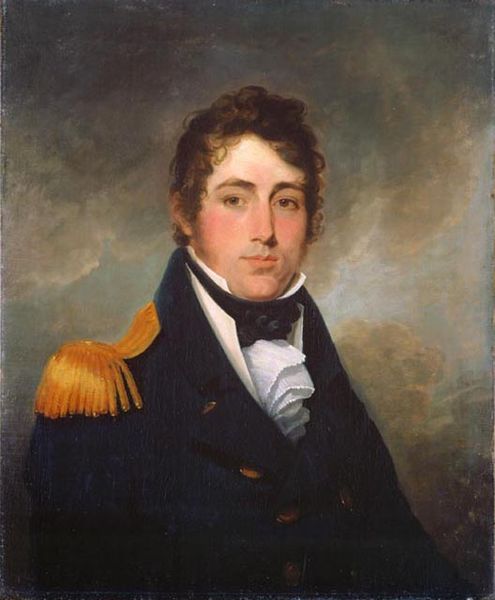
Wallis in 1813
I am always amazed at just what change – political, technical, economic, scientific – can occur in a single human lifetime. I was reminded of this when I saw a reference in an 1895 book to the demise in 1892 of Admiral of the Fleet Sir Provo Wallis. He was 101 years old and his name had been entered on the Navy List for 96 of these years.
This was due to Wallis’s father, a clerk in the Naval Yard at Halifax, Nova Scotia, getting his name entered as an able seaman on a frigate, HMS Oiseau, when he was just over four years old. Such sharp-practice was common in the period, though usually with much older boys, and they did not actually go to sea until some years later. They were however amassing seniority. It is probable that Wallis did not actually serve afloat until he joined the frigate HMS Cleopatra as a midshipman in 1800. By 1809 he was a lieutenant on the sloop-of-war HMS Curieux (captured French ships retained their names when serving in the Royal Navy).
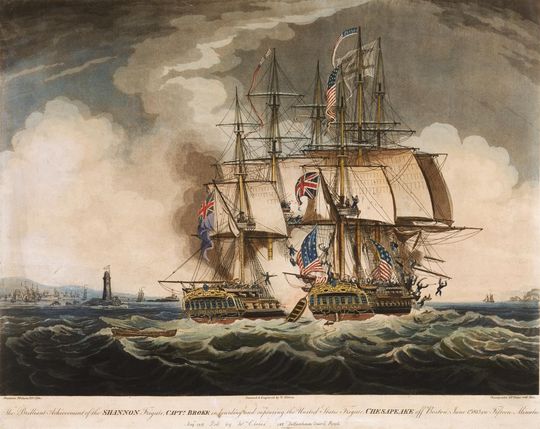
The Shannon-Chesapeake action Jun 1st 1813
Wallis’s moment of glory was to come in 1813, when he was serving as second lieutenant on board the frigate HMS Shannon when she fought her victorious action against her counterpart USS Chesapeake on June 1st, 1813. When Shannon’s Captain Philip Broke was badly injured and her first lieutenant killed, the twenty-two year old Wallis took command.
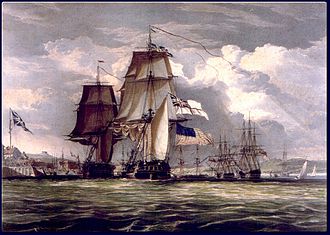 Wallis, in Shannon, leads the Chesapeake into Halifax
Wallis had the honour of taking the captured Chesapeake into his home town, Halifax, Nova Scotia and the victory was especially significant for having ended a series of Royal Navy defeats inflicted by American ships.
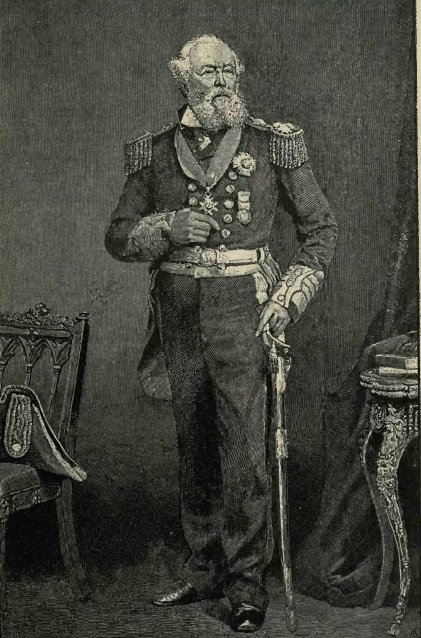
Sir Provo Wallis in old age
Wallis was to have a distinguished career afterwards, his last active service being in 1858, retiring as an Admiral in 1863. He was to benefit from a special clause in the Navy’s retirement scheme of 1870 that allowed for officers who had commanded a ship in the wars with France up to 1815 to be retained on the active list for life, thus drawing pay. The few days Wallis was in command of Shannon thus qualified him to remain on the active list until he died. (It is sad to note that the clause was inserted to save two old admirals who were dying as paupers). Being on the active list meant he was liable, in theory at least, for call-up for a seagoing command and in his late nineties he confirmed that he was ready to accept one. He probably meant it too!
The French Revolution was under way, but the Reign of Terror had not commenced, when Wallis was born in 1791. When he died Kaiser Wilhelm II was German Emperor (an empire that did not exist until 1871) and the seeds of the First World War had been sown. Wallis had grown up in the Royal Navy of Nelson and Cochrane, the age of wooden sailing ships. He saw the introduction of steam propulsion, rifled breech-loaders, steel construction, torpedoes, and much else. The most powerful Royal Navy ship of his youth was a 100-gun three decker – in the year of his death the title was held by HMS Royal Sovereign, of the first pre-dreadnought class, one of which, HMS Revenge, was to bombard the Belgian coast in 1914 and 1915.
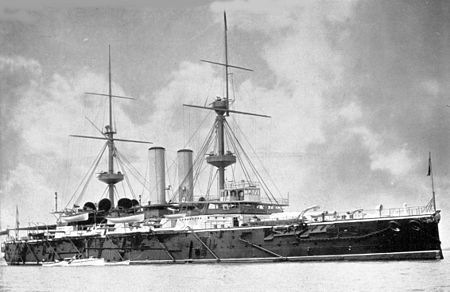 HMS Royal Sovereign, commissioned in the year of Wallis’s death
His lifetime had seen the discovery of bacteria, antiseptics and anesthetics, the arrival and spread of railways across the world, the shrinking of distance, even intercontinentally, by telegraph, the invention of the telephone, light bulb and internal combustion engine, the electrification of cities and , the extension of the franchise in Britain – the list is endless.
And all in the space of one human life.
Britannia’s Spartan
Number 7 of the Dawlish Chronicles series
Read in sequence or as a stand-alone novel
 It’s 1882 and Captain Nicholas Dawlish RN has just taken command of the Royal Navy’s newest cruiser, HMS Leonidas. Her voyage to the Far East is to be a peaceful venture, a test of this innovative vessel’s engines and boilers.
But Dawlish has no forewarning of the nightmare of riot, treachery, massacre and battle he and his crew will encounter.
A new balance of power is emerging in the Far East. Imperial China, weak and corrupt, is challenged by a rapidly modernising Japan, while Russia threatens from the north. They all need to control Korea, a kingdom frozen in time and reluctant to emerge from centuries of isolation.
Dawlish finds himself a critical player in a complex political powder keg. He must take account of a weak Korean king and his shrewd queen, of murderous palace intrigue, of a powerbroker who seems more American than Chinese and a Japanese naval captain whom he will come to despise and admire in equal measure. And he will have no one to turn to for guidance…
Britannia’s Spartan sees Dawlish drawn into his fiercest battles yet on sea and land. Daring and initiative have already brought him rapid advancement and he hungers for more. But is he at last out of his depth?
For more details, click below:
For amazon.com For amazon.co.uk For amazon.ca For amazon.com.au
Below are the thirteen Dawlish Chronicles novels published to date, shown in chronological order of main action. All can be read as “stand-alones”. Click on the banner below for information on each. All are available in Paperback or Kindle format and can be read at no extra charge by Kindle Unlimited or Kindle Prime Subscribers.