18th Century Naval Chaplains – and a rascally journalist
All line-of-battle ships and frigates were allowed chaplains during the Royal Navy’s “Age of Fighting Sail”. The decision to have such men in a ship, usually referred to as “parsons”, may well have rested with individual station commanders. Some admirals and captains were famed for their piety – most notably Admiral of the Fleet James Gambier, 1st Baron Gambier (1756 –1833) – but others were likely to be more casual in their observances in the more usual manner of the less than pious 18th Century.
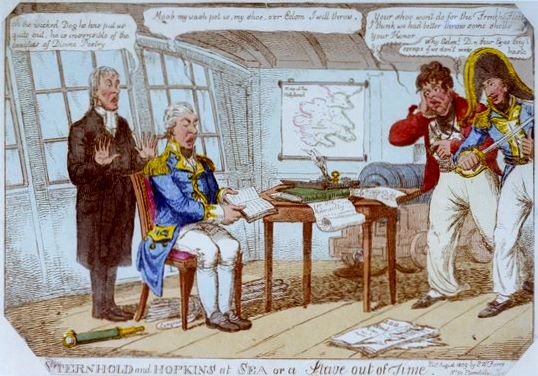
The pious Lord Gambier and the fire-eating Lord Cochrane during the Battle of Basque Roads in 1809. Gambier, backed by his chaplain, is shown reading the Bible and ignoring Cochrane’s request to pursue the French fleet
Such men were expected not only to conduct divine service on Sundays and funerals in the case of fatalities, and take their place in the cockpit during battle to assist the surgeon in matters likely to be temporal no less than spiritual, but also to act as schoolmasters for the midshipmen.
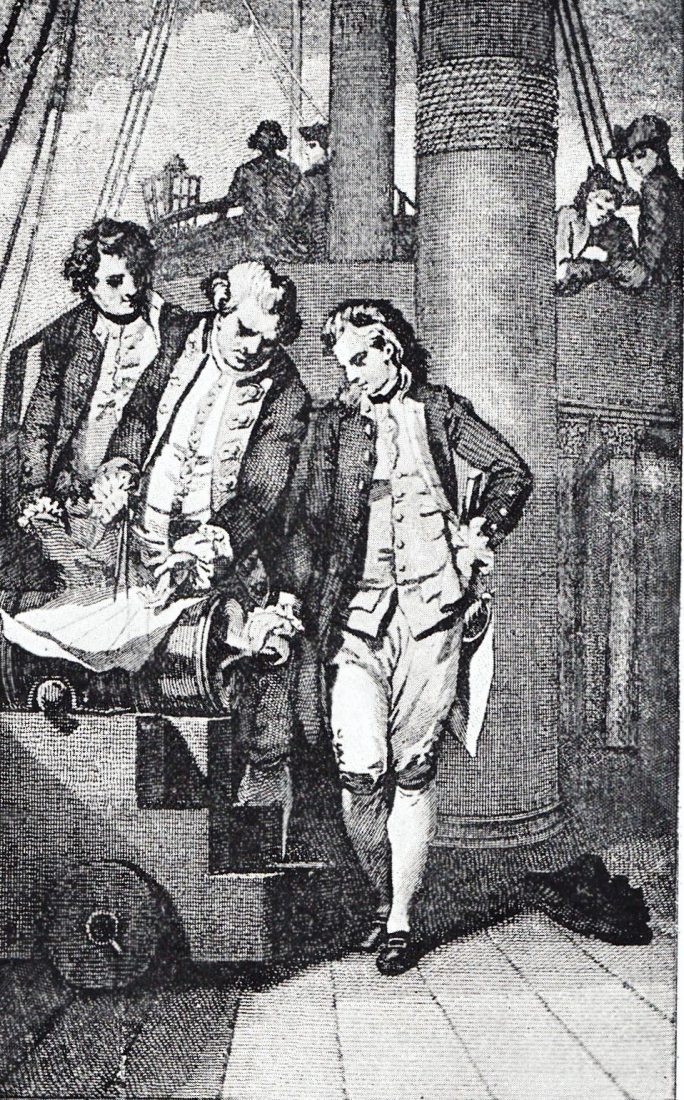 The future King William IV under instruction as a midshipman
on HMS Prince George, 1779
It is likely that these clergymen varied enormously in motivation, attitude and piety. Some were almost certainly unlikely to have been able to obtain “Livings” ashore – which were often in the gift of wealthy landowners – and some might have had good reason to be absent from the country on the grounds of financial or moral embarrassment of one sort or another. Some would have been genuinely pious and for many with a scientific bent the opportunity for research in foreign parts would have been irresistible.
I came to thinking about such men when I stumbled upon a brief discussion of them in an 1894 book, “The British Fleet” by Commander N. Robinson. It suggests that when chaplains were first assigned, towards the end of the 17thCentury, they were not always welcome on board, and for a surprising reason. Having time on their hands chaplains tended to write journals, and to prevent having any such “true relations of their voyages” published, sometimes highlighting faults and blunders, many “gentlemen-captains” preferred not to have them in their ships.
One chaplain who did however write was the Rev. Thomas Pocock, M.A., chaplain of HMS Orford, in 1698, Ranelagh in 1704, and Union in 1711. His journal principally relates to the operations of the Ranelagh off the Spanish coast, the capture of Gibraltar, and the battle of Malaga. Pocock summarised a typical Sunday’s duties as “I preached this morning on the quarter-deck, read prayers about 4. I catechized first the volunteers and then the officers’ boys, and I distributed about 100 books among the ship’s crew. I gave six young gentlemen 6d. a piece for learning the 6 first Psalms.” The mention of the 100 books – probably tracts or pamphlets – is interesting in that it may hint at a higher standard of literacy on the lower deck than we perhaps think typical of the period.
The most entertaining assessment – satirical but probably with more than a grain of truth – appears in “The Wooden World Dissected “ (1706), written by Ned Ward (1667 – 1731), about whom we’ll say more further on. Ward had spent time at sea and he stated that “a sea-chaplain is one that in his junior days was brought up in fear of the Lord; but the University reasoned him out of it at last, and he has ofttimes thanked his good stars for it. . . . There’s as great a difference betwixt him and a reverend divine as betwixt a quack doctor and a learned physician ; and he will never show it more than when you offer to tell him so, for he’ll be readier to confute ye with his fists than any other proofs whatever. . . . He drinks and prays with much the like fervour, and to show his abundant humility he will sometimes drink flip with the midshipmen; and, to prevent the fall of a weak brother, he will oft be so charitable as to drink for him. He wears his prunella gown as chearily (sic) as he does his honesty ; there’s something in the wind to be sure when he puts on either. The captain, when he has got a super-ordinary dinner, sends for him to give the Benediction, but he gives no long-winded Grace, for he loves to keep his breath to cool his pottage. He’s the captain’s trusty camarade (sic) at a game or so, on a Sunday evening, but they play not so deep as they drink a hearty Bout prevents the spiritual food of the day from lying heavy on the stomach, there being no better digester of good doctrine than good liquor.”
Ward combined the occupations of journalist and tavern-keeper after travels to Jamaica and New England, in neither of which he made his fortune. His first success came with “The London Spy”, a satirical work published in 18 monthly installments which purported to be a “complete survey” of the London scene. He built on its success with over one hundred further satires in prose and verse which targeted just about every power and interest group of his time. He also got so heavily involved in politics and in 1706 he was twice arrested for “seditious libel” of the Whig government and condemned to stand in the pillory on both occasions. Like his contemporary journalist Daniel Defoe, he was popular with the London mob and therefore seems to have come uninjured through this ordeal.

Ned Ward (1667-1731)
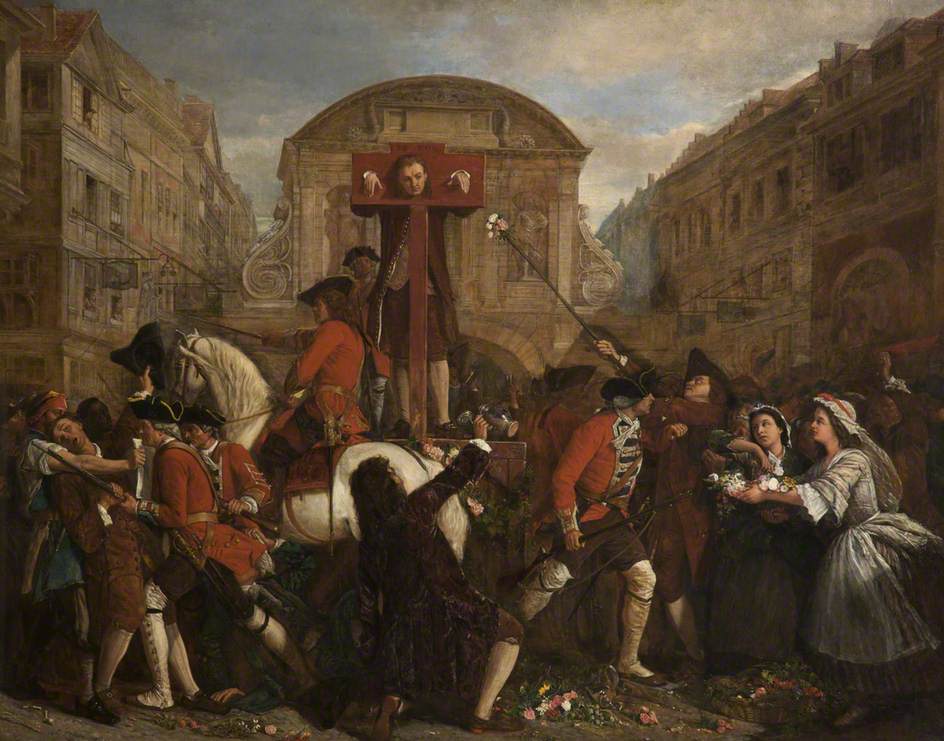
Daniel Defoe (of Robinson Crusoe fame) in the pillory –
so popular that the crowd threw only flowers at him
Ward’s writings became popular even in the Americas, and it must be to his credit that he evoked the ire of the Puritan supporter of the Salem Witch Trials, Cotton Mather. This luminary warned in 1726 against pestilences “all those worse than Egyptian Toads (the Spawns of a Butler, and a Brown, and a Ward…)”. One suspects that Ward would have been rather proud of this!
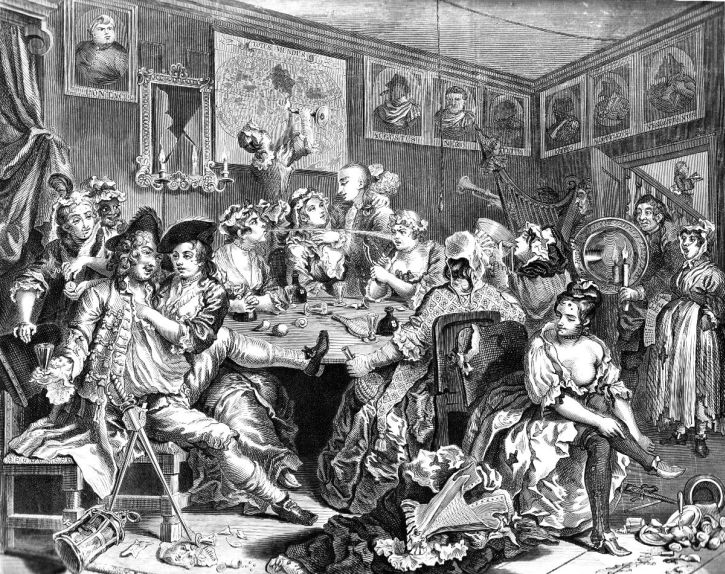
Low life in Georgian London as William Hogarth depicted it and as Ned Ward would have enjoyed it
A list of the names of some of Ned Ward’s pamphlets, as below, is a delight in itself – the first on the list is especially intriguing – and I’d like to learn more myself about this colourful character.
Female Policy Detected, or, The Arts of a Designing Woman Laid Open (1695)
Sot’s Paradise (1698)
The Weekly Comedy, as it is Dayly Acted at most Coffee-Houses in London (1699)
A Journey to Hell (1700–1705)
The Dissenting Hypocrite (1704)
Honesty in Distress but Relieved by No Party (1705)
Hubibras Redivivus (twelve monthly parts, 1705–1707) – the bitter attack on the Whig government that led to Ward being put in the pillory
The Wooden World Dissected (1706) – a controversial account of the Royal Navy ( see extract above)
Mars Stript of his Armour (1708)
The Secret History of Clubs (1709) – which contains one of the first descriptions of the gay scene in London.
A Vade Mecum for Malt-Worms (1715)
The Delights of the Bottle (1720)
A man who thought up titles like these must have been entertaining to know – though not if one was to become the target of his satire!
Britannia’s Spartan
Number 7 of the Dawlish Chronicles series
Read in sequence or as a stand-alone novel
 It’s 1882 and Captain Nicholas Dawlish RN has just taken command of the Royal Navy’s newest cruiser, HMS Leonidas. Her voyage to the Far East is to be a peaceful venture, a test of this innovative vessel’s engines and boilers.
But Dawlish has no forewarning of the nightmare of riot, treachery, massacre and battle he and his crew will encounter.
A new balance of power is emerging in the Far East. Imperial China, weak and corrupt, is challenged by a rapidly modernising Japan, while Russia threatens from the north. They all need to control Korea, a kingdom frozen in time and reluctant to emerge from centuries of isolation.
Dawlish finds himself a critical player in a complex political powder keg. He must take account of a weak Korean king and his shrewd queen, of murderous palace intrigue, of a powerbroker who seems more American than Chinese and a Japanese naval captain whom he will come to despise and admire in equal measure. And he will have no one to turn to for guidance…
Britannia’s Spartan sees Dawlish drawn into his fiercest battles yet on sea and land. Daring and initiative have already brought him rapid advancement and he hungers for more. But is he at last out of his depth?
For more details, click below:
For amazon.com For amazon.co.uk For amazon.ca For amazon.com.au
Below are the thirteen Dawlish Chronicles novels published to date, shown in chronological order of main action. All can be read as “stand-alones”. Click on the banner below for information on each. All are available in Paperback or Kindle format and can be read at no extra charge by Kindle Unlimited or Kindle Prime Subscribers.