Hoche and Maréchal Canrobert
1892 Ramming Disaster
Ramming proved a successful manoeuvre in battle on only one naval battle – at Lissa in 1866 – but ram bows were seen as essential features for warships of almost all sizes in the half-century prior to WW1. Such bows – extended forward underwater to end in a sharp point that could gouge deep into an enemy hull – were to prove a major hazard in peacetime. Naval vessels exercising manoeuvres in close proximity to each other were obviously most at risk. Accidental ramming was to prove fatal in several major “blue on blue” disasters. (Click here to access). The tragedy of it all was that ramming would have been very difficult to achieve under modern battle conditions since improved long-distance gunnery, and higher ship speeds, would have made it virtually impossible to ram a major enemy vessel.
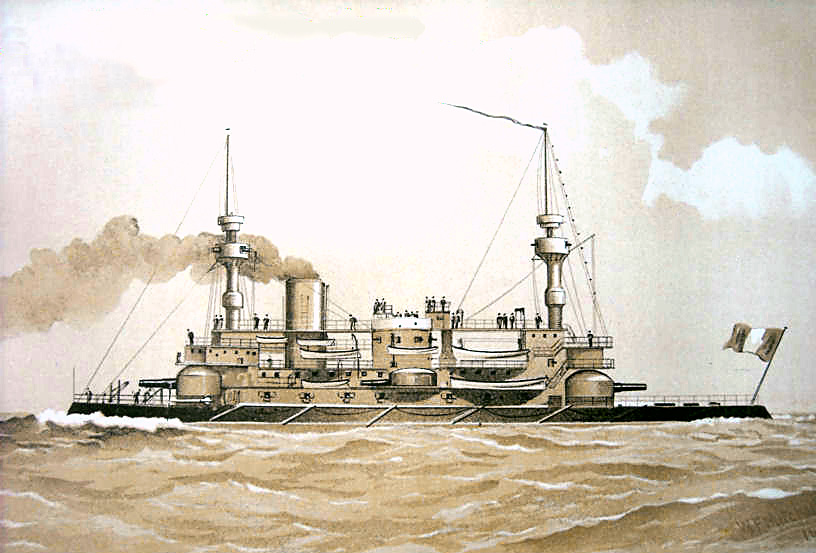
“Le Grand Hotel”
Another addition to the sad list of ramming disasters occurred in July 1892 and involved the French battleship Hoche. When she entered service in 1890, this vessel represented the epitome of a major warship designed as much for ramming as for carrying heavy guns. Entering service in 1890, this 12,000-ton, 322-foot vessel was protected along her waterline by an armoured belt 18-inches thick while her main armament, of two 13.4-inch and two 10.8-inch cannon, was protected by up to 16-inches of armour. Two features were especially notable – the enormous and untidy superstructure, that led to her the nickname of “Le Grand Hotel”, and the long ram-bow that ended in a vicious point some eight feet below water level.
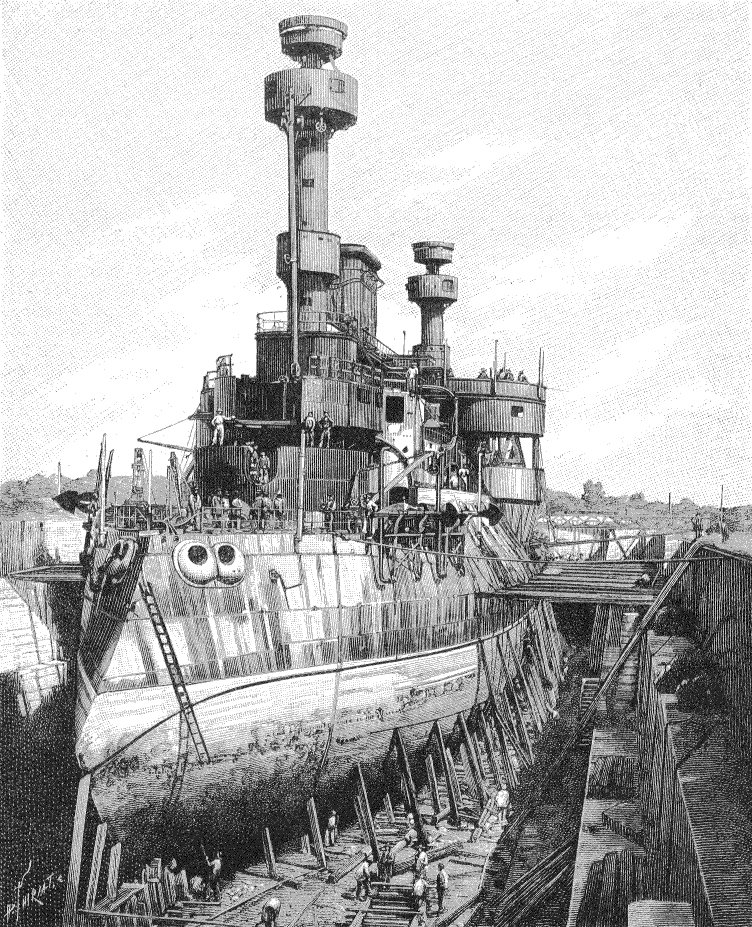
Hoche in drydock. Note the pointed ram
Heading for an unscheduled appointment with the Hoche on July 7th 1892 was the passenger steamer Maréchal Canrobert. Built in Scotland, and in service since 1881, this 1200-ton 250-foot iron-hull vessel carried mail and passengers between France itself and the French possessions in North Africa.
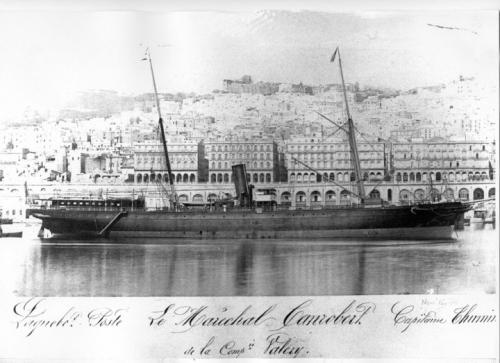
Maréchal Canrobert
On the day of the disaster, the Maréchal Canrobert was nearing Marseilles, following an uneventful passage from Bone (now known as Annaba) in Algeria. Some nine miles south-west of her destination, the Maréchal Canrobert encountered the Hoche exercising in company with other naval units of the Mediterranean Fleet. Contemporary newspaper accounts are light on detail but an impression is gained that the Maréchal Canrobert’s captain brought his ship dangerously close to the warships, possibly to provide a better view of their manoeuvres to the passengers on deck. The Hoche had been firing her guns – and the propellants of the time yielded vast clouds of dense gunsmoke – and it was surmised that the Hoche’s officers did not see the passenger steamer until it was too late to take evasive action.
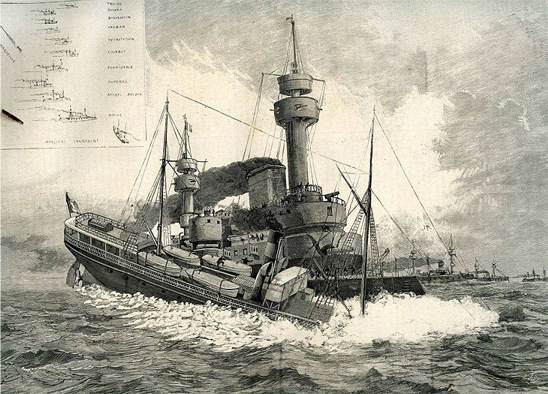
Contemporary illustration of the disaster
The Hoche’s ram bit deep into the Maréchal Canrobert, all but severing her in two. Naval disciple prevailed however and the shattered – and sinking – remains were secured to the battleship to facilitate transfer of survivors. Boats were also launched. Despite these efforts the Maréchal Canrobert disappeared within eight minutes of the collision. The resulting death-toll amounted to 107. Blame for the disaster was placed on the captain of the Maréchal Canrobert.
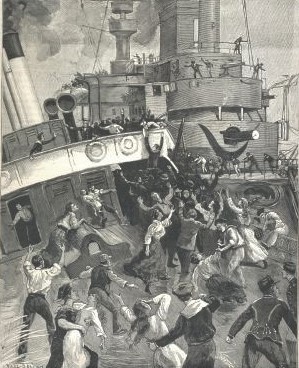
Survivors being brought on board Hoche
The ram had claimed yet another peacetime victim but some two decades were to pass before such bows finally passed out of fashion. Such is the power of the paradigm. (Click here to read of another ramming disaster, in 1891, in which the ship with the ram was lying at anchor)
Start the 13-volume Dawlish Chronicles series of novels with the chronologically earliest:
Britannia’s Innocent
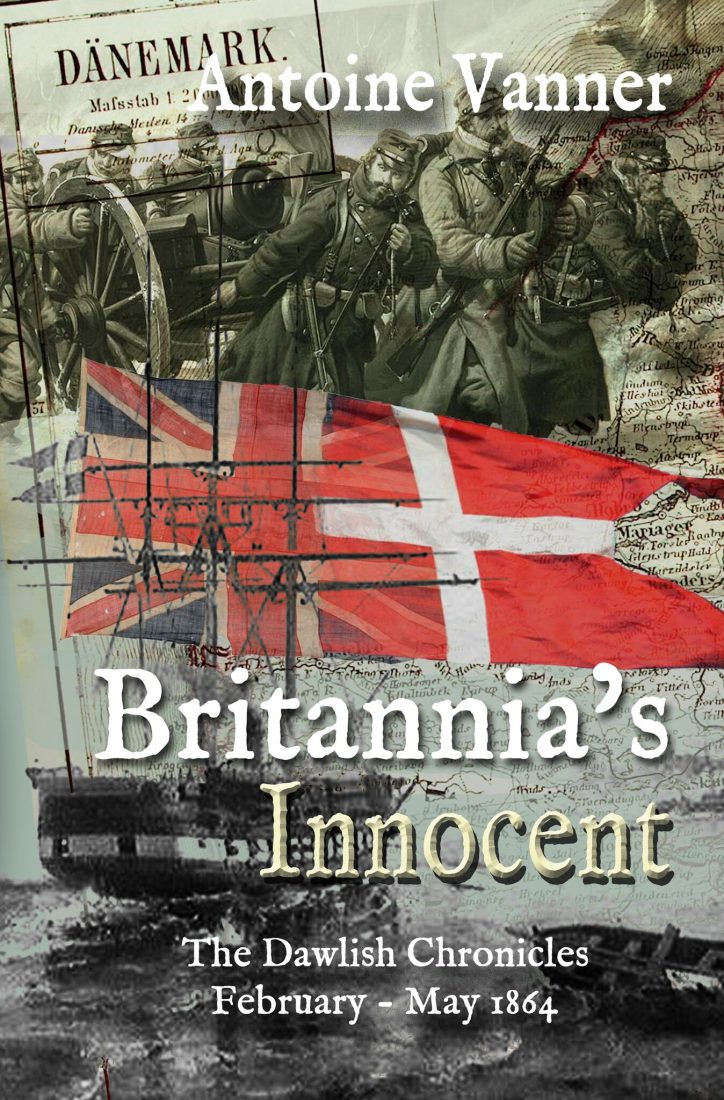 It’s 1864 and war has come to Denmark, brought on by political folly and waged against the mighty forces of Prussia and Austria. With no allies to turn to, a determined Danish commander leads his men northward, refusing to call it a retreat. Pursued by Austrian cavalry through snow, sleet, and mud, their resolve is tested with every punishing mile.
Across the Atlantic, another conflict rages. The American Civil War spills onto the world’s oceans as Confederate raiders strike Union shipping as far away as the East Indies. Now a powerful new ironclad, nearing completion in a British shipyard, threatens to shift the balance—if she can ever be armed. The Union wants her destroyed. The Confederacy wants her unleashed. And Denmark may yet gain her, if secret bargains can be struck.
Into this maelstrom steps a young Royal Navy officer: Nicholas Dawlish. Newly returned from service in the West Indies, he volunteers unofficially to aid Denmark, drawn by ambition and adventure. Thrust into the brutal realities of siege, bombardment, and bitter fighting on the cold waters of the North Sea, he must learn fast if he is to survive.
In later years, Dawlish will be known as a shrewd. In 1864 he’s already a professional but in the cynical ways of the world he is still an innocent, and all the more vulnerable for that.
The first novel in the acclaimed Dawlish Chronicles series, Britannia’s Innocent begins the saga of a man whose fate will be shaped by courage, conflict, and the tides of history.
For more details, click below:
For United States For UK & Ireland For Canada For Australasia
The Dawlish Chronicles – now up to thirteen volumes, and counting. Click on image below for details