Lonely Lives and Deaths
French Prisoners of War in Britain 1793 – 1815
Part 2
This is the second part of a blog about the experiences of French Officer POWs in Britain during th Napoleonic Wars. If you missed it, Click here to read Part 1 which explained the system involved for accommodating prisoners who had given their parole and were all owed to live relatively normal lives in British towns such as Alresford in Hampshire.
The most notable reminder of the Napoleonic-era French prisoners in modern Alresford is to be found in the graveyard of the ancient church of St. John the Baptist.
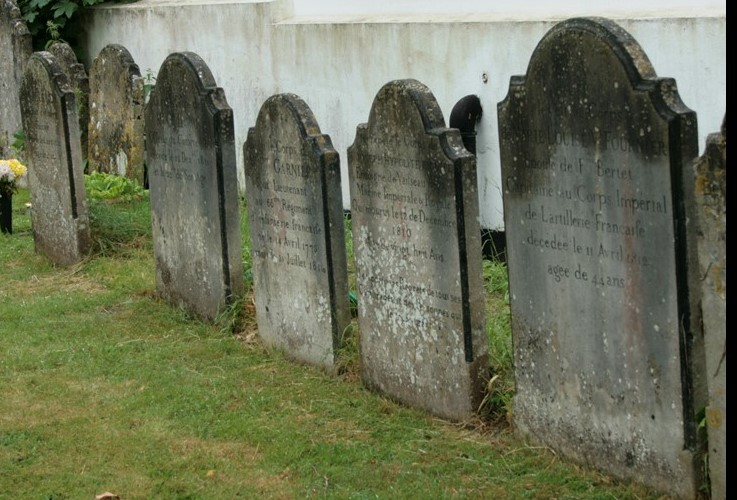
Sad French Graves in Hampshire, far from home
Here one can find headstones which commemorate four prisoners, and the wife of another, who lie buried here. A small plaque alludes to deaths brought on by tropical diseases carried back from the West Indies. Though brief, the inscription on each stone tells a tale of tragedy.
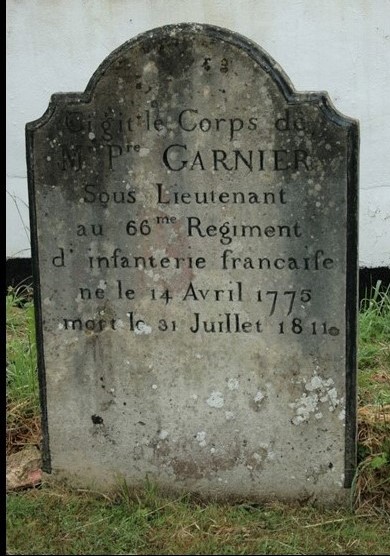
Pierre Garnier – Sub-Lieutenant of the French 66th Regiment of Foot, died on 31st July 1811 at the age of 36. I have been unable to locate a book written about him by Audrey Deacon and entitled “The Prisoner from Perrecy” (1988) but his details appear to be that he had served since 1796 and sailed to Guadeloupe in 1810, being captured that year in the British attack that eliminated this last French base in the Caribbean. Garnier arrived in Alresford in June 1811 but already appeared to be ill, possibly due to a fever brought from West Indies. Before dying he prepared a claim for arrears of half-pay to which he was entitled as a prisoner but the claim was not settled (on behalf of his heirs) until six years after the end of the war.
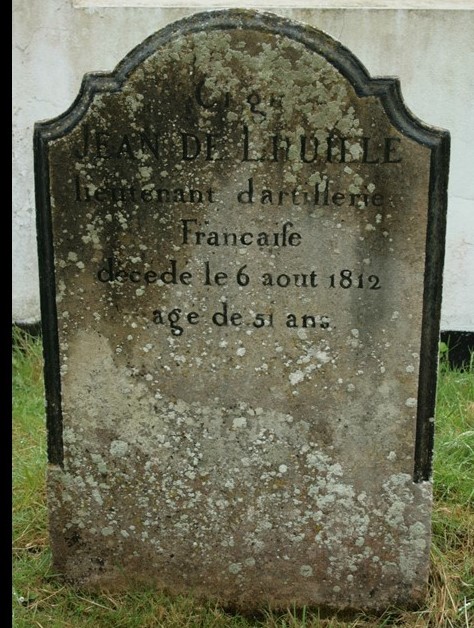
Jean de Lhuille – Lieutenant of Artillery, died August 6th 1812 at the age of 51. He was the oldest commemorated with a headstone and considering his junior rank one wonders what his story might have been. Was he a promoted ranker? Was he perhaps a civilian but enrolled in some part-time militia on Guadeloupe and captured at the same time as Pierre Garnier?
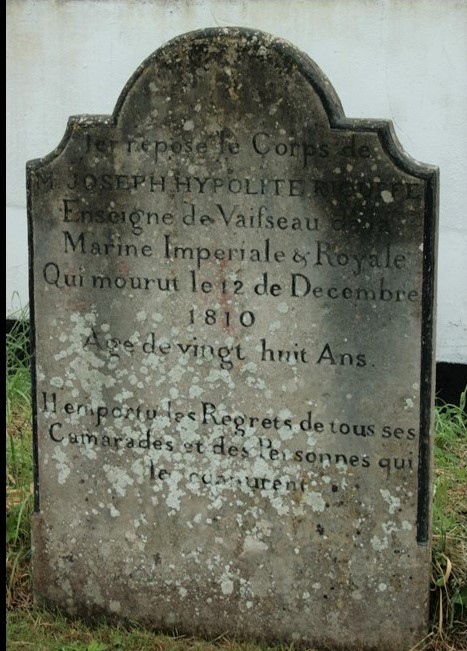
Joseph Hypolite Riqueffe – Naval Ensign, died December 12th 1810, aged 28. It is interesting that his affiliation is given as the “Imperial and Royal” French Navy and not the “Imperial” alone. He was “regretted by his comrades and all who knew him” and one suspects that the latter category was not confined to Frenchmen. (See more below in “Bonus Material”)
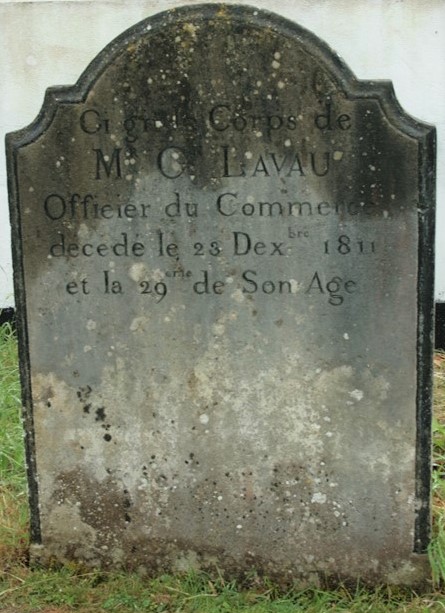
M.C. Lavau – Merchant Navy officer, died December 23rd 1811 at the age of 29. Given that much of Britain’s naval war against Napoleon was a war against commerce, and conducted with higher standards of humanity than the U-Boat wars of the 20th Century, there is a good chance that he might have been captured at sea.
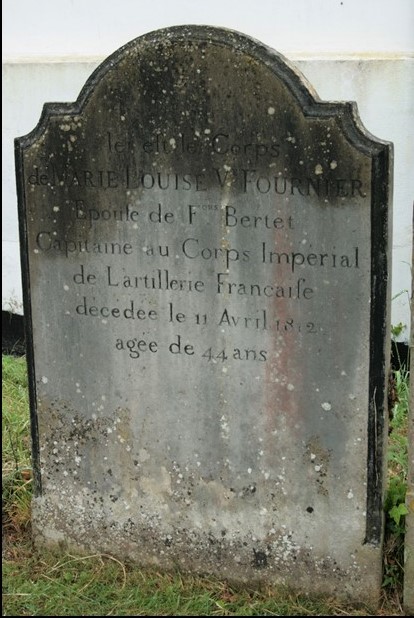
Madame Marie Louise Fournier – wife of Captain F. Berlet of the French Artillery, died 11th April 1812 aged 44. This is the saddest of the gravestones and one wonders how she had come to be in Alresford. Had she perhaps been captured with her husband, perhaps in Guadeloupe, and had she volunteered to stay with him? Had he perhaps been wounded and needing nursing? Or had she offered to come across from France to Britain to stay with him after he had been captured somewhere else? (See more below in “Bonus Material”)
Yet in parallel with these tragedies life went on as pleasantly as it could and relations between British hosts and reluctant French guests seem to have been generally cordial. French prisoners seem to have participated in social gatherings and one such was to be at The Swan Inn (still in business as the Swan Hotel and proud of having once hosted Oliver Cromwell) in 1810 when the agent, John Dunn, and other Alresford notables were invited to attend an Anglo-French assembly to celebrate Napoleon’s marriage to Marie-Louise of Austria. Somebody must have tipped off the Admiralty’s Transport Board, which then prohibited the celebration as being unpatriotic. It is also notable that the tradition of prisoner of war theatricals, which was so much a feature of WW2 POW camps, especially British ones, seems to have been well established in Alresford. On one occasion some spoilsport at the Transport Board got wind of the fact that French officers had formed a theatre and warned John Dunn that if it continued the prisoners would be moved elsewhere. One hopes that this warning was treated by the residents of Alresford with the contempt it deserved!
Other than Conan Doyle’s Brigadier Gerard’s brief captivity in Britain, and Robert Louis Stevenson’s St. Ives, I know of only one notable work of fiction which builds on social relations between the British and their French prisoners. This is a tragic short story by Rudyard Kipling in his “Rewards and Fairies” and it centres on a girl who, unknown to herself, is dying of consumption. Her father has become friendly with a French prisoner, a real-life doctor, René Laennec (1786-1821), who is in the process of inventing the stethoscope (Laennec’s presence in Sussex as a prisoner-of-war is a fictional invention of Kipling’s, but it makes for a great story!). Another friend is Arthur Wellesley, later Duke of Wellington, who is just back from India. The climax of the story is an unbearably poignant account of a dinner at which all the men realise that the girl is dying, but she does not know it herself. Wellesley, who himself was partly educated in France, would have had no hesitation to be on friendly terms with a cultivated Frenchman like Laennec, prisoner or not. I’d like to think that social interactions of this type were not uncommon – and there’s scope here for many a convincing fictional plot!
Bonus Material:
When I originally posted material about these graves about fourteen years ago I received a very gracious reply, as follows, from the historian Paul Chamberlain, who has written two books on the subject. These are “The Napoleonic Prison of Norman Cross” and “Hell Upon Water” about the POW hulks. (Amazon UK links are: https://amzn.to/3R0rvgf and https://bit.ly/3RqoXbf )
I repeat the reply below in its entirety. Odiham. the village which Mr. Chamberlain also refers to, is about a dozen miles from Alresford and appears to have been another parole town. Even today, by its architecture, it has a definite Georgian feel to it. If Mr. Chamberlain reads this, I’d like to express my thanks again and would be delighted to hear from him.
From Paul Chamberlain: I have read with interest your blog on the prisoners held at Alresford, and can add a bit more information about some of those who are remembered with headstones in the churchyard.
Joseph Hypolite Riouffe was captured when serving on board the 36-gun frigate Furieuse on 6th July 1809. The vessel was armed en flute (with only twenty guns mounted) as she was taking stores to the French colony of Martinique. The ship was taken by HMS Bonne Citoyenne (herself an ex-French prize) while in the Atlantic.
Marie Louise Fournier was the wife of Captain Francois Bertet and captured when he and other members of the garrison of Guadeloupe became prisoners in February 1810. While wives and children were not considered combatants, and could go home whenever they chose, she elected to stay with her husband in England.
A lot of the officers captured when Guadeloupe fell were sent to Alresford and Odiham, as prisoners tended to be kept in batches, as it were. I have not found the death certificates for these prisoners, so cannot say what they died of. They would often contract an illness when in captivity, and this could include anything going through the town at the time e.g. influenza, diphtheria, and anything else that would cause ‘fever’. I did find the death certificates for the two prisoners buried at Odiham, but these were buried at the bottom of a box of ‘Miscellaneous documents’ in the National Archives that I came across quite by chance. The certificates for Alresford are probably buried in such a box, of which there are a lot of odds and ends of Transport Board documents bundled up and put into such boxes. I may come across them by chance one day.
In preparing the above article I, Antoine Vanner, have been heavily indebted to the “About Alresford” website and to an article on it by Peter Hoggarth, dating from 1991, on the French prisoners. The photographs have been taken by myself.
Antoine Vanner’s only non-fiction book:
Broadside and Boarding
Small scale action in the Age of Fighting Sail 1740 – 1815
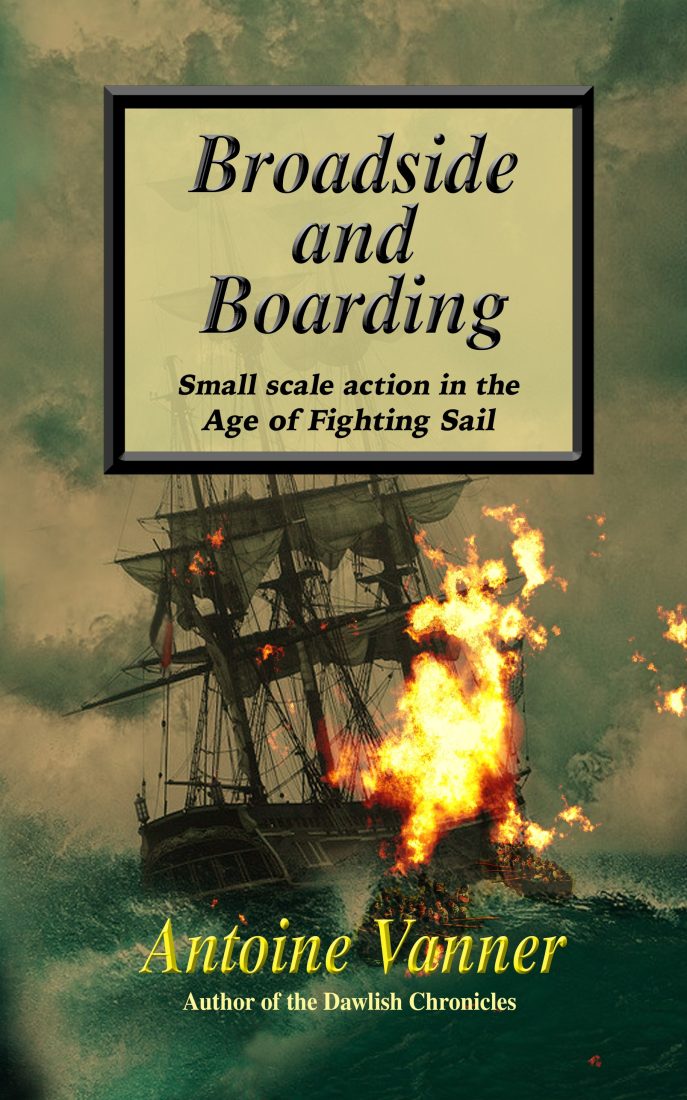 Antoine Vanner is a novelist, not a formal historian. Broadside and Boarding is his only non-fiction work, though he has published thirteen volumes so far of the Dawlish Chronicles series of naval adventures, set in the late 19th Century.
This new book refers to an earlier era, the Great Age of Fighting Sail that spanned the years 1740 – 1815. It tells largely forgotten real-life stories of small-scale actions, not of the great fleet battles like Trafalgar. Many involve little more than a handful of resolute men fighting their own lonely and desperate battles, small epics that still inspire.
Broadside and Boarding is not a formal history but a collection of some eighty articles. Reading times vary from ten to fifteen minutes. They’re ideal for coffee or tea breaks, for when one is waiting for a train or flight, for delays of all kinds and for when mood precludes a prolonged reading session. This is a book that belongs on bedside tables and in guest rooms, in cars’ glove compartments or, in Kindle format, in briefcases and handbags, always readily accessible.
Uncovering these stories demanded searches not just in classic and near-contemporary histories of the time but in smaller and obscure books perhaps unopened for decades. In many cases there are direct quotes from reports or letters written in the immedate aftermath of the events involved. These are often touching and sometimes inspirational, bridging the centuries through recognition of our shared humanity.
Click links below for details:
USA UK and Ireland Canada Australia and New Zealand