Bombardment and U-Boat action off Gaza
November 1917
November 1917 saw the key battles that allowed British and Anzac forces to break through from the Sinai Peninsula and into Palestine. Turkish and German defences extended from the Mediterranean at Gaza to Beersheba, some 35 miles inland in the desert. Earlier efforts, in March and April 1917, had proved incapable of breaching defence lines that were to become even stronger thereafter. High casualties were suffered by the Allied forces in these assaults – some units sustaining up to 50% loss levels. Not until October 1917, under a new British commander, General Edmund Allenby, with reinforcements that included deployment of tanks for the first time outside Europe, was a sufficient force available to achieve the necessary victory and drive back the Turkish and German defenders. The subsequent British and Anzac advance – which involved inspired use of aircraft, armoured cars and horsed-cavalry – led to capture of Jerusalem on 9th December. This achievement was hailed by Prime Minister Lloyd George as “A Christmas present for the British people”.
The bombardment unleashed on the Turkish defences at Gaza prior to the final assault was comparable in intensity to that which preceded the opening of the Somme offensive in 1916. Army artillery opened up in 27th October and was joined two days later by fire from a powerful Anglo-French naval force. The British contingent in this included the large monitor HMS Raglan (which carried two 14-inch guns), the small monitor M15 (one 9.2-inch), the small monitors M29, the M31, and M32 (one 6-inch each), the old protected cruiser HMS Grafton (two 9.2-inch and ten 6-inch), the river-gunboats HMS Ladybird and HMS Aphis (two 6-inch each), with protection provided by the destroyers HMS Staunch and HMS Comet. The French vessels included a small coastal battleship, the Requin – a relic from the mid-1880s which had been rebuilt in 1900-02. Armed with two 10.8-inch weapons, she had previously provided sterling service in defence of the Suez Canal. The French force also included five destroyers.
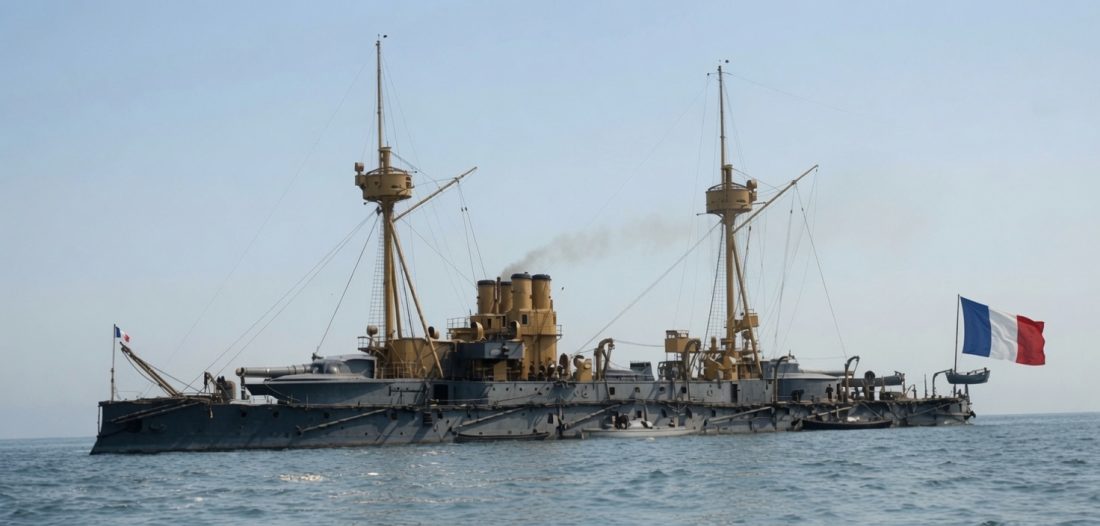
Requin in the 1890s, as originally completed
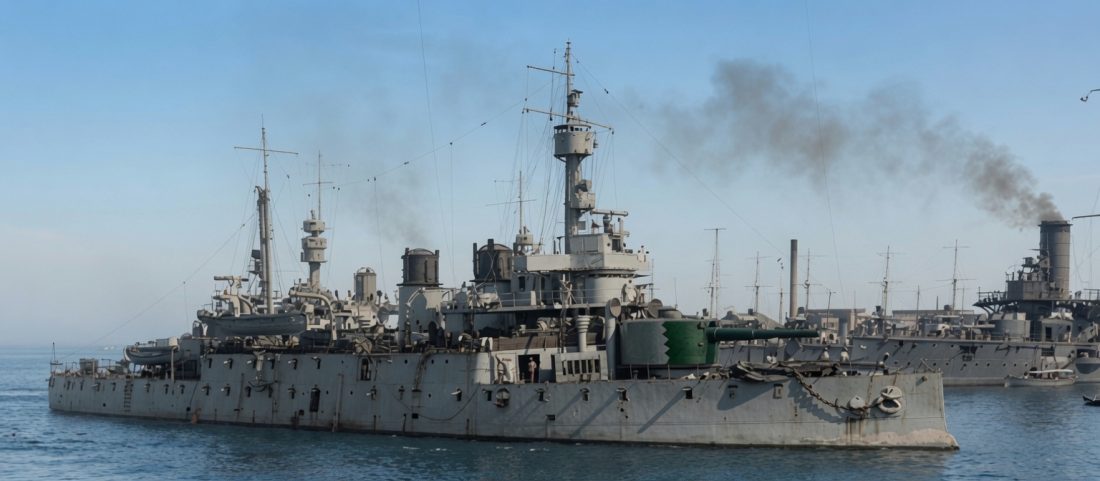
Requin, as reconstructed, seen in WW1. Despite her age she rendered invaluable service
During the nine-day shore bombardment not all these ships were in action at once as they had to be rotated back to Port Said for refuelling. Opposition came from bombing by Turkish aircraft and by shore batteries , the Requin taking a serious hit that caused 38 casualties. The bombardment reached its crescendo on the night of 6-7th November, after which the Turks abandoned their positions and commenced their retreat.
It was in the aftermath of these intense operations that the bombarding force was to sustain its most serious loss. Responsible for this was one of the small German U-boats that operated with such deadly effect from the Austro-Hungarian base at Pola, in the Adriatic. The SM UC-38 was a Type UC II submarine, of which 64 were built. These had minelaying as its primary task, but they also carried a small torpedo armament. They are perhaps the most successful submarine type ever, being responsible for some 1800 sinkigs. Of only 509-tons submerged, and 165-feet long, UC-38 carried 18 mines in six mine-dropping tubes as well as two torpedo tubes forward and one aft. In nine cruises, beginning in October 1916, she was to sink no less than 43 Allied ships, either by torpedo or by mines laid. This success reflects the fact that anti-submarine warfare was in its infancy, especially as regards detection, so that U-boats could operate close inshore with some impunity, unlike the situation in WW2.
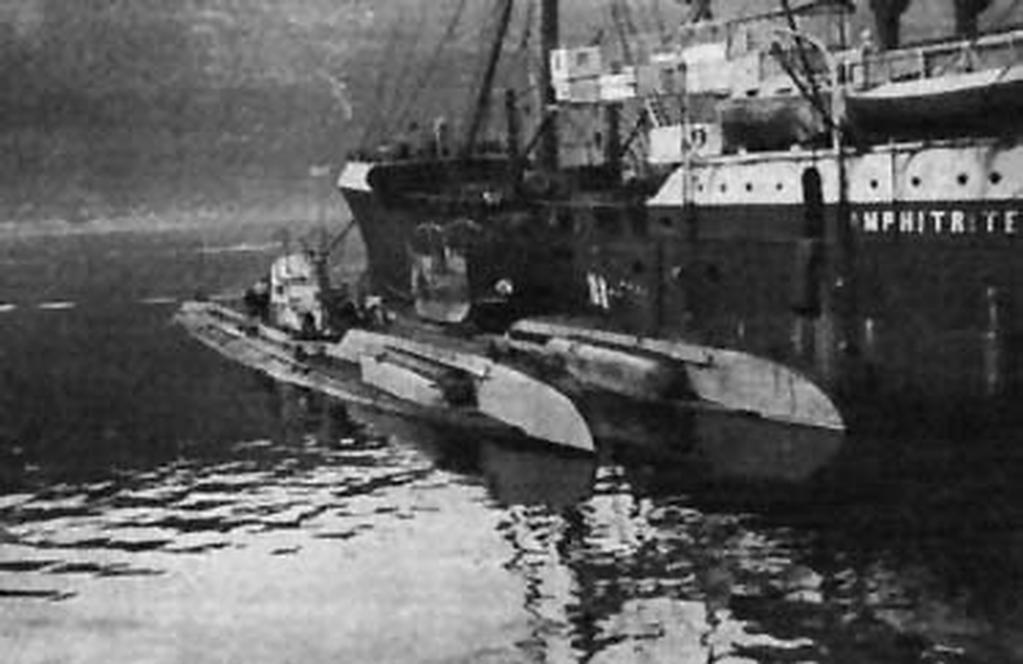
Two UC II boats seen alongside an Austro-Hungarian depot ship
It was inshore, off Gaza, that UC-38’s captain, Hans Hermann Wendlandt launched a daring attack on the night of 11th November. His victims were to be the small monitor M15 and the destroyer HMS Staunch. The M15 was an especially interesting vessel, one of a class of fourteen vessels (M15-M28), of 540-tons and 177-feet long, which had been authorised in early 1915 and rushed into service within a few months for shore bombardment. Unarmoured, cheap and suited for construction by yards normally involved in construction of small civilian ships, they were armed with 9.2-inch guns taken off obsolete cruisers. They were to see very active war service in the Mediterranean, off the Belgian coast and, post-war, in the British intervention in the Russian Civil War. Three, including the M15, were lost to enemy action. HMS Staunch was a modern destroyer, of the Acorn class, built in 1910. Hit by torpedoes fired by the UC-38, both vessels sank with loss of life – twenty-six on the M15 and eight on the Staunch. These vessels were the 38th and 39th to be sunk by the small German submarine.
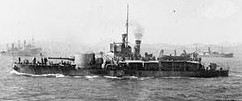
HMS M15
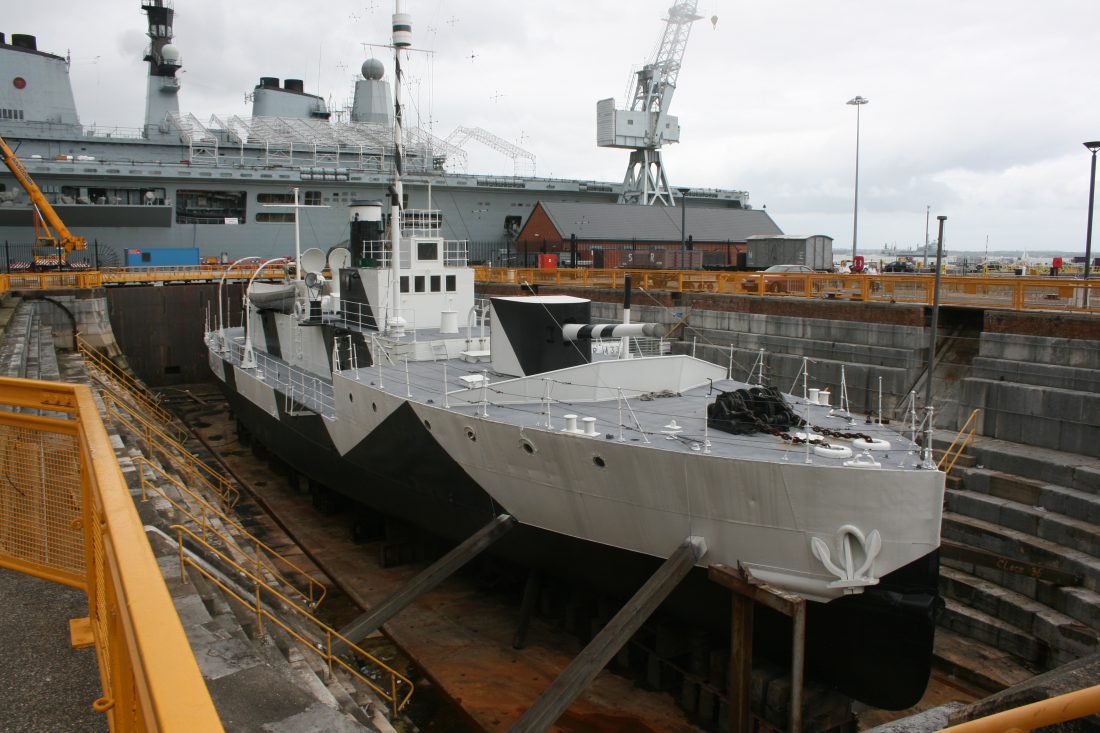
None of the M15 – M-28 monitors survives but M33, preserved at Portsmouth Dockyard, is generally similar
The UC-38 was not detected and made a successful escape, heading back towards her base at Pola. Three days later she encountered, and sank, two Greek sailing traders south of Corfu. One of her mines laid off the Gulf of Patras, sank a French naval patrol-trawler on December 6th. The UC-38’s luck was finally running out, however.
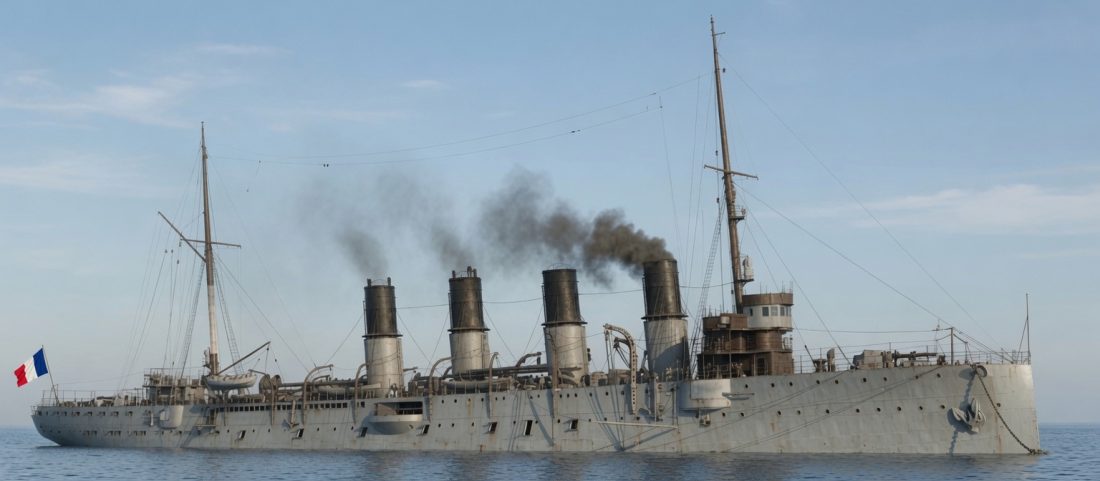
Chateaurenault – designed for commerce-raiding – her profile made her look like a passenger liner if seen from afar
At dawn on 14th December, off the Greek island of Kefalonia in the Ionian Sea, and on the home-straight for her base at Pola, UC-38 encountered the French cruiser Chateaurenault, of 8200-tons and 460 -foot length. This vessel was serving as a troop-carrier and escorted by three modern destroyers, Mameluk, Rouen and Lansquenet and a trawler, Balsamine. In an act of either daring or foolhardiness UC-38’s commander decided to press an attack, regardless of the presence of the escorts. A single torpedo was fired, hitting the Chateaurenault squarely amidships. Two of the French destroyers, Mameluk and Rouen, commenced a search but the UC-38 had dived to some 120 feet and could not be detected. The third destroyer, Lansquenet, commenced picking up survivors thrown overboard by the explosion. Though still afloat, Chateaurenault now requested the destroyers to come alongside and take off personnel – and activity that was completed satisfactorily within an hour – while the Balsamine tried to take the stricken cruiser in tow.
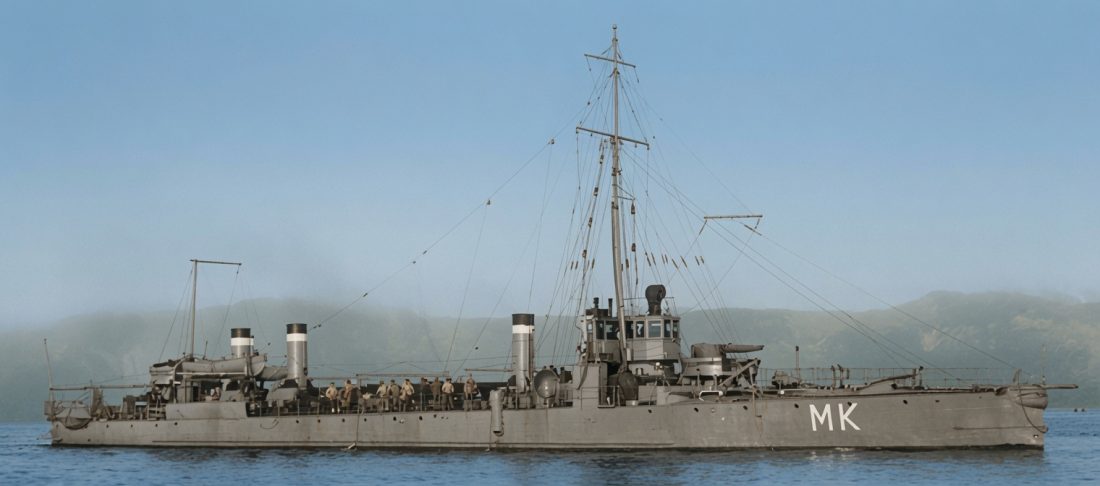
French destroyer Mameluk
The UC-38 had not however left the scene and some two hours after her first attack she launched a second torpedo at the Chateaurenault. This was the cruiser’s coup-de-grace and she sank quickly. The destroyer Lansquenet now initiated a depth-charge attack in the general area from which UC-38 must have fired her torpedo. An attempt to escape by diving failed and confusion resulted in the submarine climbing instead. As she did, a depth charge exploded close by, causing a large leak. There was no option but to surface and, as she did, she was targeted by more depth charges. As she broke surface she was hit by gunfire from both Mameluk and Lansquenet. Most of her crew managed to jump overboard before she sank and the French ships picked up twenty out of a complement of twenty-eight.
HMS M15 and HMS Staunch had been avenged.
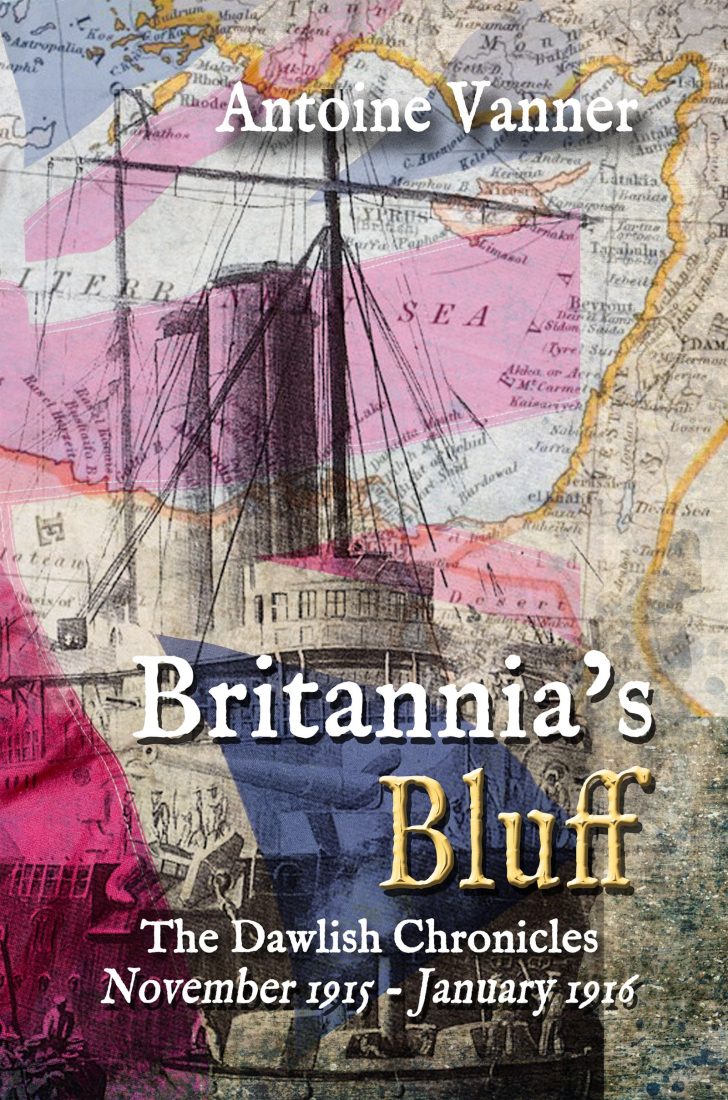
Britannia’s Bluff
November 1915 – January 1916
The Royal Naval Air Service, RNAS, plays a key role In Britannia’s Bluff, the 13th volume chronologically of the Dawlish Chronicles series. It’s found operating floatplanes off a carrier converted from a fast mail-packet steamer, landplanes from an improvised airstrip and even a small squadron of Lanchester armoured cars.
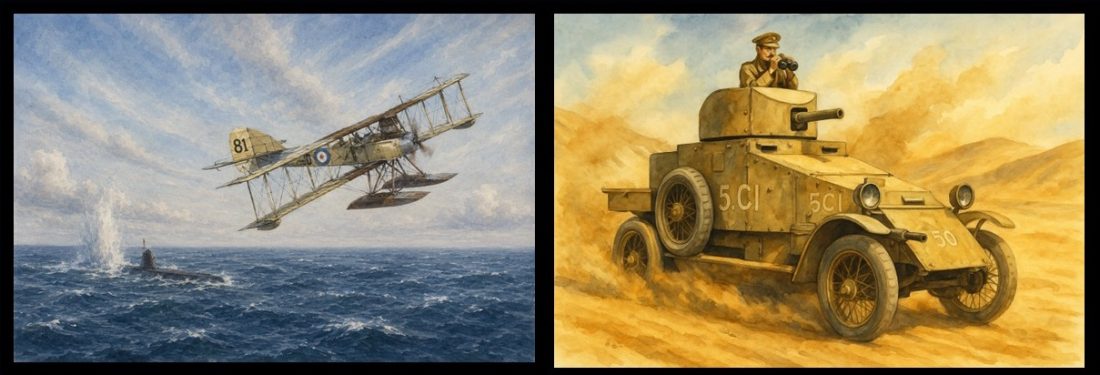
 It’s November 1915: The Great War rages. Britain has failed to break through the Dardanelles Strait to open a supply route to its Russian allies.
Over 80,000 allied troops are trapped in tiny footholds on the rocky Gallipoli peninsula. Weakened by disease and exposure, they are dominated by Turkish artillery and entrenchments on higher ground. Repeated attempts to advance have resulted in mounting casualties. Now, with winter looming, victory is unachievable. But evacuation from the landing beaches could bring yet worse tragedy . . .
Admiral Sir Nicholas Dawlish, sees one chance – a colossal bluff – to reduce the risks of evacuation. He plans a lightning diversionary campaign at sea, on land and by air.
But will it be in time to help prevent a final bloodbath at Gallipoli?
It’s available in hard copy and Kindle. Subscribers to Kindle Unlimited can read it (like all others volumes in the series) at no extra charge. It can be enjoyed as part of the series or as a standalone story.Purchase Links below.
Australia & New Zealand Click here.
The Dawlish Chronicles – now up to thirteen volumes, and counting …
Click on image below for details